Previous Exit Next
Swashbuckling Tales from the Saga of Bob Nasmith©2020 Brian H. Lumley, photos by Alex Mac Donald This is my personal story about some of my experiences with the Canadian actor and soldier of fortune, Bob Nasmith. Bob and I came from the same neighbourhood on the Niagara Peninsula. He lived in the city of St. Catherine’s, 13 miles from my hometown of Beamsville. As a war baby he was of my older brother’s and sister’s generation, but he fit so well into mine, the baby boomers. He had more life experience than most of us and he led the way. We first bumped into each other in the Niagara underground theatre community in 1968. A year later we reacquainted ourselves in Rochdale. Back in 1968, my puritan style upbringing had led me to think of street theatre as an embarrassingly foolish activity and just horsing around. Bob put a different spin to it: he made it more of a wakeup movie. He showed me how I had been unwittingly performing street theatre by growing my beard and hair, I let my hair grow until I was ordered by the high school principal to cut it. He pointed out that every time I had worn homemade tire sandals to school I was protesting the war he had been a part of, he liked that. He made me realize the fact that I played and sang protest songs on the sidewalk was another act of street theatre. To me Bob, living by his own rules, represented the triumph of the human spirit. He knew there are rules within rules with boundaries to be challenged and he was game for the adventures. Seizing the moment and taking ahold of the real escapades of the moment was our real connection. Along with his real life exploits and experiences came tales that others decided need to be embellished. Bob wanted those fantasies brought back to earth and put into back human context. He has been put on several shelves as a member of the heroes with a thousand faces. He did not feel that about himself and he wanted his real stories recorded somewhere. Bob created some great scenes, in and out of Rochdale. Some morphed into legend and some were so outrageous they were hard to believe. I never heard him totally deny any of them, but he didn’t want them embellished with bullshit either. He knew I was leaving my life long vocation as a carpenter and starting to write about incidents I was a part of. Early in 2019 we were talking about some of his legendary activities, I brought up a couple of incidents we were both part of. We reminisced them together, he was glad to find I recalled what he wanted remembered. He was fine with true tales about him. In no uncertain terms he told me he did not want false yarns being spread. Especially those that stretched the truth or brought other people unrealistically into the fray. We discussed incidents that were considered common folk lore, and he told me what he wanted remembered. We shook hands and I agreed only to write stories about him sans bullshit. We talked about our early history on the Niagara Peninsula and this is what he told me about himself when he left. –- In the early-mid 60’s, Bob left our boring Ontario neck of the woods, with “Ladies and Escorts” and “Gents” signs over the doors to the bars, for greater adventures in the open society of the United States. He started working as a bellhop in San Francisco at the beginning of the Hate Ashbury era – Yahoo!! this was more like it. After some repeated unruly drunken public behavior, whilst living by his own rules, he found himself in front of a judge. Looking at the record, our Bob had acquired over a short time period, the magistrate recognized that what this young man needed was a little discipline. The wayward Canadian was offered either a stint in jail then deportation in disgrace or the honour of serving the country he was having so much fun in and enlisting in its army. Our paladin chose to toe the line with the brave going to defend America in Viet Nam. Bob was a scrapper and the army taught him several special methods of how to stay alive with his bare hands as well as with weapons. The fighting instructions for Viet Nam were different than the army’s previous conventional training. Soldiers were trained to fight a group of assailants and how to street fight. He learned how to subdue, maim and kill with his hands. When he came back into society, he had to pay attention to these dangerous skills and not use them. He did not talk often about his military life, but one night in 1998, at a party at Rickie Waern’s, a group of us got him to talk about his Bronze Star. The first thing he said was everybody in the platoon got one, he wasn’t special. He told us a story that sounded more surreal than anything. The platoon he was in had basically shot themselves out of someplace they shouldn’t have been in the first place. The officer had gotten them lost and they wandered into a small squad of the enemy. One of the men in his platoon was killed but they had killed more Vietnamese. It was near the beginning of the conflict, US intervention was still being called a police action and America needed some positive propaganda, so the flub up was spun to look like something it wasn’t. Bob did not like the act of medal giving in war. To most of their recipients they were reminders of a part of their lives they would have rather lived a different way. Many people awarded these medals lived with nightmares the rest of their lives. Those of us with veterans in our family understood some of what he was saying. When asked about carrying and using his gun, he said he was lucky and just good enough to not get killed himself. He had a natural awareness of danger and understood the skills of self-preservation. He was a good marksman, and could calculate when he was a sniper’s target and acted accordingly. He said he believed in ducking and camouflage. Bob was a gambler, he understood beginner’s luck and that luck was fickle. During a live firefight in the jungle, in an act of clarity and consciousness, he picked up the downed company photographer’s camera and started taking pictures. From that time on he carried his weapon but avoided using it. He was a good shot with a gun and the camera took its place. He photographed the images his rifle sites would have looked for. His live action work was published in some of the main magazines of the era. He said he was also involved in the first newspaper written for and by the US troops in Viet Nam. Another revealing comment he made was that he was glad he was over there early and did not have to deal with the greater activity after the Tet offensive. He felt sorry for everybody sent over and the whole country that had to deal with the situation. This I had heard from every WW2 veteran that was in a war zone at the end of the conflict. 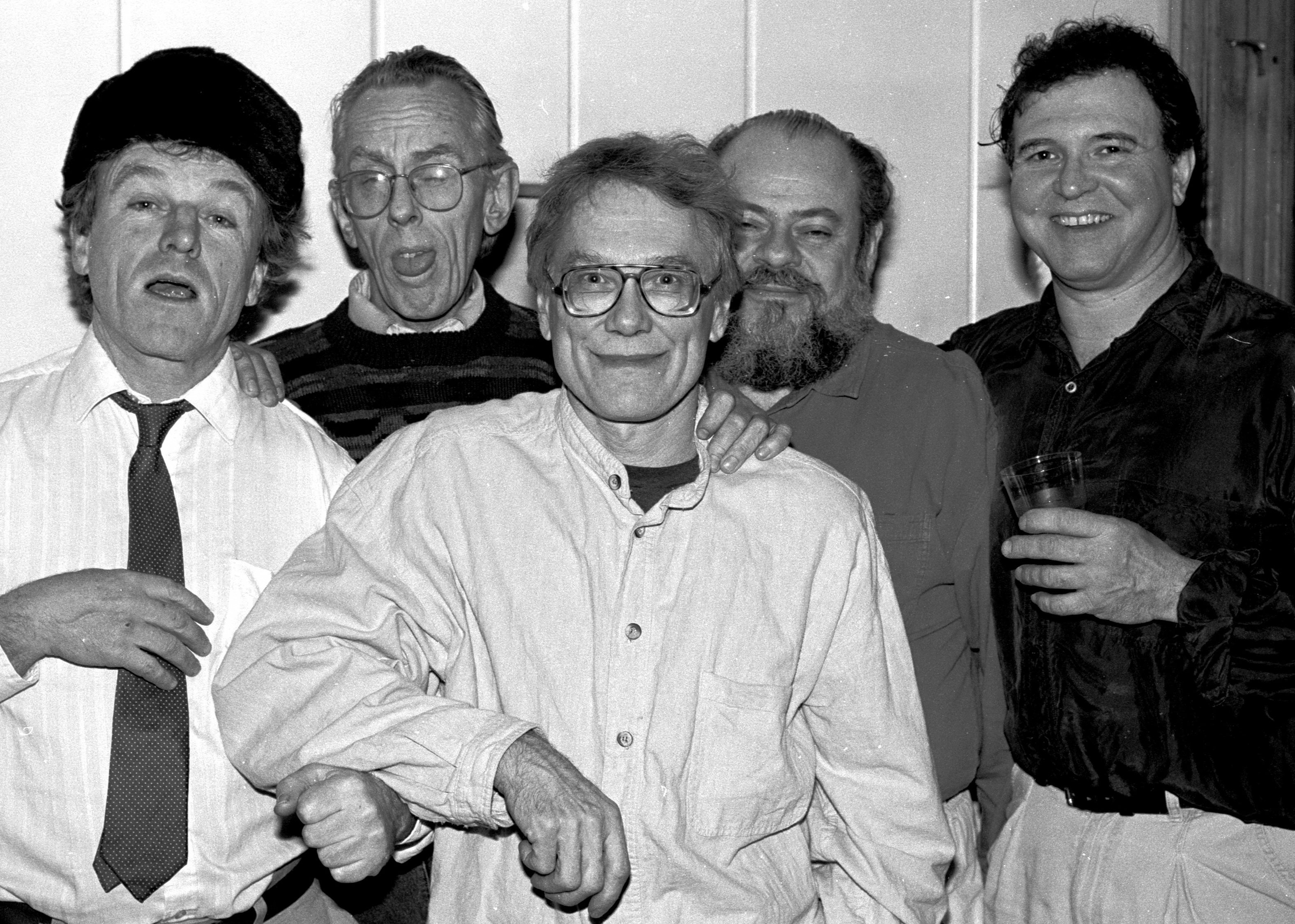
Rochdalians 1998 - Bob Nasmith, Jay Boldizar, Ricky Waern, Lorne Gould, Brian H. Lumley |